A comprehensive guide on packaging standards, climate-appropriate material selection, and country-specific customs requirements for companies exporting to the Middle East.
The Middle East Is a Massive Market — But Is Your Packaging Ready?
The Middle East represents one of the largest export destinations for Turkish manufacturers. Turkey supplies 47 percent of all corrugated board exports to the region, making it the single largest supplier. That figure reflects deep industry experience with the region. But from years of working with exporters, we can say this with certainty: in Middle East trade, packaging quality matters just as much as product quality. Shipments delayed at customs, boxes deformed by moisture, or consignments rejected for labeling deficiencies mean both financial loss and reputational damage.
So what does your packaging need to withstand when exporting to Iraq, Saudi Arabia, and the UAE? Which standards are mandatory, and what climate tests should you consider? In this guide, we have compiled everything you need to know for these three major Middle Eastern markets.
Why Packaging Is So Critical in the Middle East
The Middle East's geography creates three fundamental challenges that directly impact packaging engineering:
- Extreme heat: Summer temperatures in inland areas exceed 50 degrees Celsius. Inside shipping containers, temperatures can reach 70 degrees Celsius. Under these conditions, adhesives weaken, print colors fade, and corrugated board loses its structural integrity.
- High humidity: Coastal areas along the Persian Gulf — particularly Dubai, Abu Dhabi, Jeddah, and Basra — experience relative humidity above 90 percent. Corrugated board absorbs moisture and loses significant compression strength.
- Strict customs inspections: All three countries enforce rigorous checks on labeling, marking, and certification. Deficiencies in any of these areas can result in shipments being held or returned at customs.
These three factors elevate packaging from a simple protective wrapper to a strategic component of your export operation.
Iraq: Accessible but Detail-Oriented
Iraq is one of Turkey's largest export markets, and geographic proximity offers clear logistical advantages. However, that proximity should never lead to complacency about packaging requirements.
Marking and Labeling Rules
Iraqi customs requires that all markings on packaging be applied directly using ink or paint. Removable labels, adhesive-attached cards, or any markings that can be easily detached are not accepted. For corrugated box manufacturers, this underscores the importance of offset or flexo printing — the marking must be an integral part of the box itself.
Certificate of Conformity (COC)
Products exported to Iraq require a Certificate of Conformity (COC), which is issued bilingually in Arabic and English. Exporters must obtain this certificate through an accredited inspection body prior to shipment.
2025 Updates
The Iraqi Customs Authority has transitioned to electronic declarations through the ASYCUDA World system. This digitization means exporters need to work with their customs brokers to ensure declarations are compatible with this system. Additionally, revised tariff rates now range from 5 percent to 150 percent — always verify the current tariff for your specific product category.
Key Packaging Considerations
- All information on boxes (country of origin, contents, weight) must be applied by direct printing
- Arabic labeling is mandatory
- Shipments to hot inland areas (Baghdad, Mosul) should be tested for high-temperature resistance
- Shipments to coastal areas like Basra should incorporate moisture barrier solutions
Saudi Arabia: The Region's Most Comprehensive Standards System
Saudi Arabia is the Middle East's largest economy and the most rigorous when it comes to standards compliance. Adherence to standards set by SASO is an absolute prerequisite for export.
SASO Standards and the SABER System
All products exported to Saudi Arabia must be registered through the SABER platform and obtain a Certificate of Conformity. This process consists of two stages:
- Product Certificate (PC): Documents that the product complies with relevant SASO standards. This certificate is issued by an accredited Certification Body.
- Shipment Certificate (SC): Required for each individual shipment, confirming that the goods conform to previously certified standards.
Technical File Requirements
SASO mandates that exporters prepare a comprehensive technical file. This file must be prepared in Arabic and retained for a minimum of 10 years.
Accredited Certification Body Requirement
Registration on the SABER system and certification processes must be conducted through a SASO-authorized accredited Certification Body. Several accredited organizations offering this service operate in Turkey.
Key Packaging Considerations
- Arabic labeling on packaging is mandatory
- Country of origin, manufacturer details, and product description must be clearly stated
- Shipments to coastal cities like Jeddah and Dammam require particular attention to moisture resistance
- Shipments to inland areas like Riyadh must prioritize extreme heat resistance
- Packaging information must also be declared on the SABER platform
United Arab Emirates: Multiple Authorities, Single Standard of Excellence
The UAE is one of the region's most dynamic trade hubs. However, its federal structure means there is a layered regulatory system that requires careful attention.
ESMA Certification
The Emirates Authority for Standardization and Metrology (ESMA) oversees the conformity of products imported into the UAE. Certification applications are submitted through ESMA's online portal. The UAE applies Gulf Standardization Organization (GSO) standards, particularly GSO 839/1997 and GSO 2231/2012 for packaging.
Emirate-Specific Additional Requirements
Beyond federal standards, Abu Dhabi and Dubai have their own regulatory bodies. The Abu Dhabi Quality and Conformity Council (ADQCC) and Dubai Municipality may request additional inspections and documentation.
Jebel Ali Free Zone
Jebel Ali is one of the world's largest free zones and serves as the entry point for many Turkish exporters into the UAE. However, free zone status does not mean exemption from customs declarations. Goods must be declared even if duty-free, and all packaging labeling rules apply in full.
Key Packaging Considerations
- Arabic labeling is mandatory
- GSO standard compliance must be documented
- Verify emirate-specific additional requirements for shipments to Dubai and Abu Dhabi
- Moisture barrier packaging is recommended due to the coastal climate
- Packaging must be declared even for transit shipments through Jebel Ali
Common Requirement: Arabic Labeling
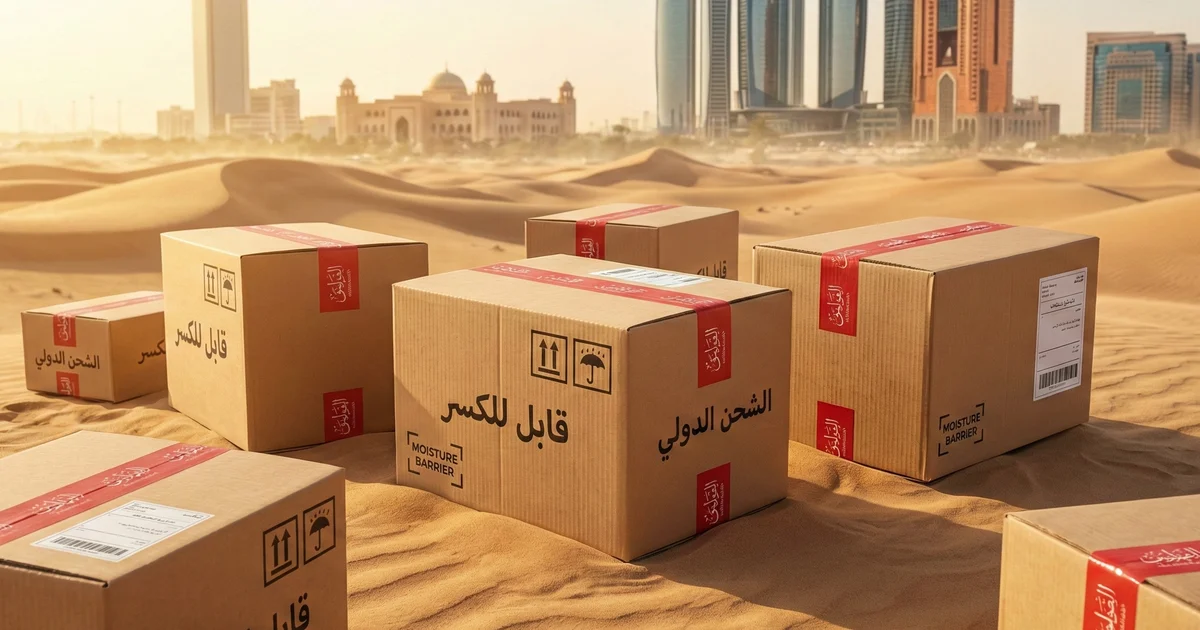
The one requirement shared by Iraq, Saudi Arabia, and the UAE is mandatory Arabic labeling on packaging. This obligation extends beyond the product label to information on the outer packaging. Country of origin, manufacturer name, product description, weight, and quantity must appear in Arabic on the box itself.
For offset-printed corrugated boxes, integrating this information directly during the printing stage is the most reliable method. Adhesive labels are not accepted in some countries (particularly Iraq) and generally risk losing adhesion due to high temperatures.
Climate-Specific Packaging Solutions
Moisture Barrier Coatings
Corrugated board naturally absorbs moisture, which directly reduces its Box Compression Test (BCT) value. In high-humidity environments, applying moisture barrier coatings is the most effective way to preserve the box's structural integrity.
Water-Resistant Adhesives (WRA)
Standard starch-based adhesives can lose bonding strength in high-humidity conditions. Water-Resistant Adhesives (WRA) prevent delamination of corrugated board layers and maintain the box's stacking strength.
Climate-Specific Testing Procedures
ASTM D4332 is the primary standard used to evaluate how packaging performs under varying temperature and humidity conditions. These tests measure critical parameters such as compression strength, dimensional stability, and adhesive bond strength.
Humidity Sensitivity of Corrugated Board
Corrugated board can lose up to 30 percent of its compression strength when exposed to relative humidity above 65 percent. For shipments to the Middle East, both material selection and flute profile should be carefully evaluated.
The Corrugated Cardboard Advantage in Export
- ISPM-15 exemption: Unlike wood packaging, corrugated board does not require fumigation or heat treatment under ISPM-15. This saves both cost and time.
- Lightweight: Significantly lighter than wood or metal packaging, corrugated board directly reduces shipping costs.
- Print and branding capability: Offset printing enables high-quality graphics and text to be printed directly on the box, including mandatory Arabic labeling.
- Recyclability: Corrugated board has one of the highest recycling rates of any packaging material globally.
- Customizability: Different flute profiles, paper weights, and coating options allow tailored solutions for specific products and climate conditions.
Middle East Exporter's Packaging Checklist
- Arabic labeling: Are country of origin, manufacturer info, product description, weight, and quantity present in Arabic?
- Marking method: Are all markings applied by direct printing?
- Conformity certificate: COC for Iraq, SABER for Saudi Arabia, ESMA for UAE obtained?
- Technical file: Arabic-language technical file prepared for Saudi Arabia?
- Moisture resistance: Moisture barrier coating or WRA adhesive applied for coastal shipments?
- Heat resistance: Container interior temperature effects assessed for summer shipments?
- ASTM D4332 testing: Packaging tested under destination climate conditions?
- Stacking strength: Sufficient BCT value ensured, accounting for moisture-related strength loss?
- Material selection: Appropriate flute profile and paper weight selected?
- Customs declaration: Packaging info correctly declared, including for free zone shipments?
Choose the Right Partner for Your Export Packaging
At MFS Ambalaj, the majority of our production since 2011 has been dedicated to serving exporter companies. Turkey is the largest corrugated board supplier to the Middle East, accounting for 47 percent of total exports to the region, and we take pride in our contribution to that position. Over the years, we have built substantial expertise in packaging solutions that meet the climate conditions and regulatory standards of this demanding market.
Our offset-printed corrugated boxes, manufactured with moisture-barrier and durable materials, protect your products through the extreme heat and humidity of the Middle East while ensuring smooth customs clearance. We also provide R&D support for size, material, and print optimization tailored to the specific product you are exporting.
The positive feedback we receive from our export clients' buyers in the Middle East confirms that the right packaging builds not just protection, but brand trust.
Contact us for your export packaging needs:
- Phone: +90 332 345 43 03
- Email: info@mfsambalaj.com
- Web: mfsambalaj.com/contact
Get in touch for a packaging solution tailored to your product and target market — we will prepare a custom proposal for you.