Shipping damage is one of the biggest challenges for e-commerce businesses. In this guide, you'll learn how to protect your products during transit with the right box selection, flute types, internal protection methods, and a practical checklist.
The Real Cost of Damaged Deliveries
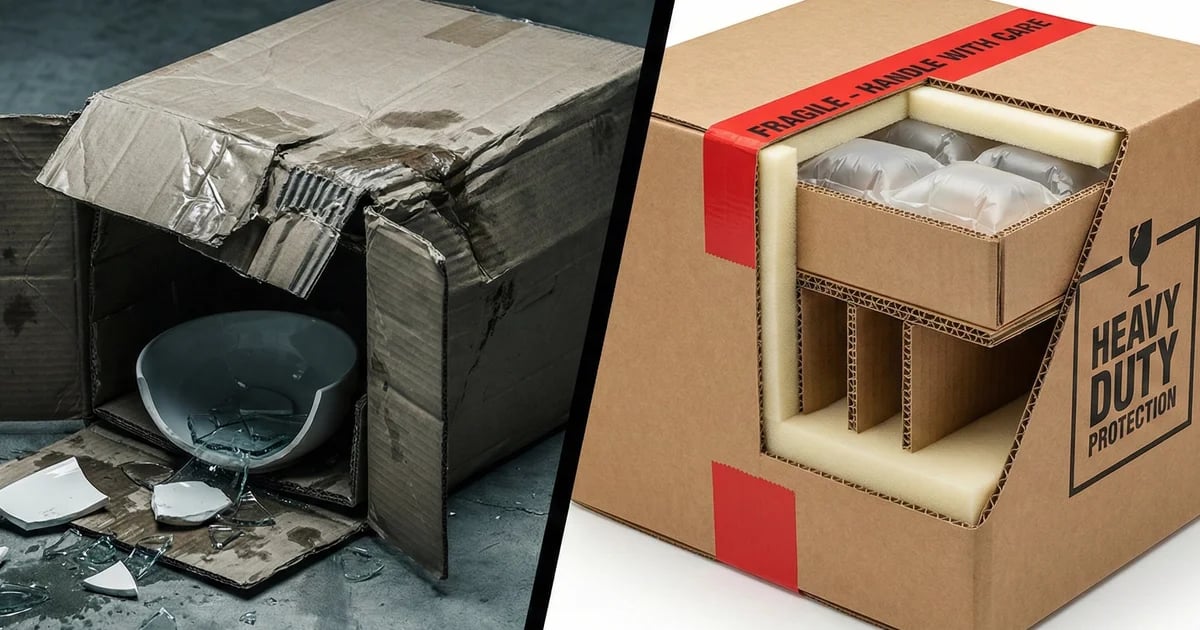
You eagerly open a package and... the product is cracked, crushed, or completely unusable. Sound familiar? It happens more often than you might think. Roughly 1 in every 25 shipped packages — approximately 3-4% of all shipments — arrives at the customer's doorstep damaged. That might seem like a small percentage, but when you scale it up, the picture changes dramatically.
In 2024, more than 85 million packages worldwide were delivered in a damaged condition — a 30% increase over the previous year. As e-commerce volume grows, the absolute number of damaged shipments rises proportionally. Looking at Turkey specifically, the shipping industry topped complaint platforms in 2024 with 156,449 complaints on Sikayetvar alone — a staggering 44% increase from the year before. One in every four complaints mentions "damaged or lost delivery."
So what is the real cost of a damaged delivery? It goes far beyond the price of the broken product itself. Consider the full picture:
- 76% of consumers who receive a damaged product will never purchase from that brand again. A single damaged package can permanently cost you a customer — and all the future revenue they would have brought.
- Return processing costs range between 20% and 65% of the product's value. Product cost, return shipping, reshipping, customer service time, restocking — when you add it all up, the total is significant and often underestimated.
- Under regulations introduced in 2026, return shipping costs now fall on the seller in Turkey. The financial burden of damage caused by poor packaging will be felt more heavily than ever before.
Then there is the brand reputation dimension. Social media posts about "my package arrived damaged" can go viral, and a single customer's bad experience can influence hundreds of potential buyers. When you consider all of these factors together, investing in packaging quality is not an expense — it is an insurance policy. In this guide, we will walk you through everything you need to know to protect your products during transit — from choosing the right box and flute type to internal protection methods and a practical step-by-step checklist.
What Happens During Shipping? Types of Damage
From the moment you place your product into a box for shipping until it reaches the customer's doorstep, there are numerous hazards along the way. A typical package can be handled more than 20 times before it reaches the end customer. Picking, sorting, loading, unloading, transferring, last-mile delivery — each touch point is a potential damage event. According to DS Smith's measurements, a typical package can be subjected to forces of up to 50G during the shipping process. Let us break down exactly how these forces occur.
Compression and Stacking Damage
This is the most common type of shipping damage. When packages are stacked on top of each other in warehouses, vehicles, and sorting centers, the load-bearing capacity of the boxes at the bottom can be exceeded. Lightweight boxes placed under heavy packages are particularly at risk. Improperly sized boxes — those that are too large for the product with empty space inside — are significantly weaker against stacking pressure because the unsupported walls buckle under load.
Drop and Impact Damage
Packages get dropped during the shipping process. This is an unavoidable reality of logistics. Typical drop heights for small packages range between 76 and 106 centimeters. Drops occur at conveyor belt endpoints, during vehicle loading and unloading, and during last-mile delivery at stairways and doorsteps. Impact forces concentrate at the box's corners and edges, and without internal protection, the product absorbs these forces directly.
Vibration Damage
During truck transportation, packages are subjected to continuous vibration in the 1-200 Hz range. On long-distance routes, this vibration can persist for hours on end. Products that are not secured inside the box will shift with the vibration, colliding with each other or with the box walls repeatedly. This is a particularly serious concern for sensitive electronics, glassware, and precision mechanical components where even minor repeated impacts can cause functional damage.
Moisture and Humidity Damage
Moisture is corrugated cardboard's greatest enemy. In an environment with 90% humidity, corrugated cardboard can lose up to 50% of its structural strength. In Turkey's coastal cities, summer humidity levels regularly exceed 70%. In humid conditions, the box softens, stacking resistance drops sharply, and the risk of compression damage multiplies. This makes moisture one of the most underestimated threats in the shipping process.
Temperature Fluctuations
Turkey's geography encompasses dramatically different climate zones. A package traveling from Istanbul to Erzurum in summer might go from 40°C ambient temperature to a -5°C cold storage facility. In winter, temperatures in Eastern Anatolia can plunge to -20/-30°C, making cardboard brittle and prone to cracking. Sudden temperature changes can also cause condensation inside the box, damaging both the packaging and the product within.
Puncture and Abrasion
During conveyor belt transit, sorting line operations, and manual handling, boxes are subjected to friction and puncture risks. Sharp-edged products can pierce the box from the inside; external objects or the corners of other packages can damage the box from the outside. Each type of damage requires a different protection strategy — and the right protection starts with choosing the right material.
The Science of Corrugated Cardboard: Key to the Right Choice
Corrugated cardboard consists of two flat paper layers (liners) with a wavy paper layer (flute) sandwiched between them. This simple yet ingenious structure gives cardboard both lightweight properties and remarkable strength. However, not all corrugated cardboard is the same. The flute type, number of walls, and grammage directly determine your box's protective performance.
Flute Types
The flute is the wavy layer in the middle of the corrugated board. The wave height and frequency determine different characteristics of the box:
- A Flute (4.8 mm): The thickest wave profile. Provides the best cushioning and shock absorption. Ideal for fragile and delicate products that need maximum impact protection.
- B Flute (3.2 mm): The denser wave structure offers superior crush resistance. Well suited for products with inherent structural strength, such as canned goods and bottles.
- C Flute (4.0 mm): A balanced profile between A and B flute. The most commonly preferred flute type for general-purpose shipping applications.
- E Flute (1.6 mm): The thin profile provides excellent print quality on the surface. Ideal for lightweight products and retail-ready packaging where visual presentation matters.
Wall Configuration
Single wall: One flute layer between two liners. Provides adequate protection for light to medium-weight products. Double wall: Two flute layers (for example, BC or AC combination) with three liners. Designed for heavy products and situations requiring high stacking strength. Triple wall: Three flute layers with four liners. Reserved for industrial-weight products and international shipping where maximum protection is non-negotiable.
ECT and Burst Strength
ECT (Edge Crush Test) measures the box's edge compression resistance and determines its stacking capacity. Practical benchmark values are as follows:
- 23 ECT: Suitable for products up to 9 kg
- 32 ECT: Suitable for products up to 30 kg
- 44 ECT: Suitable for products up to 36 kg
Burst strength (Mullen test) measures the box's resistance to pressure applied from inside to outside. It is especially important for products with sharp edges, heavy dense items, and situations where internal puncture is a concern.
Selection Guide by Product Weight
- 0-5 kg: E or B flute, single wall
- 5-15 kg: B or C flute, single wall
- 15-30 kg: C flute single wall or BC double wall
- 30-50 kg: BC or AC double wall
- 50+ kg: Triple wall
Use this table as a starting point. Your product's fragility, shape, and specific shipping conditions will also influence the final selection. When in doubt, always err on the side of choosing one protection level higher — the marginal cost increase is almost always less than the cost of a single damaged shipment.
Internal Protection: Keeping Products Secure Inside the Box
Choosing the right box is only half the battle. Securing the product inside the box and protecting it from impacts is equally important. Internal protection creates a buffer zone between the product and the box walls, preventing shocks from reaching the product directly. Here are the most effective internal protection methods available today:
Corrugated Cardboard Dividers and Separators
When multiple products are shipped in the same box — such as bottle sets, glasses, or cosmetic kits — dividers prevent the items from colliding with each other during transit. Separators made from corrugated cardboard are both lightweight and strong, and they contribute to the box's overall structural integrity. Because they are from the same material family as the box itself, they are fully recyclable without any need for sorting or separation.
Die-Cut Interior Fitments
Custom-designed interior structures that fit the product precisely provide the highest level of protection available. The product has zero movement inside the box — it is held firmly from every direction. This is the ideal solution for electronics, glassware, precision mechanical parts, and any product where even minimal shifting could cause damage. While the production cost is higher than standard filling materials, die-cut fitments reduce damage rates to near zero, which means they typically lower total costs when you factor in returns and replacements.
Corner Protectors
Stacking pressure and edge impacts are most intensely felt at the box's corners. Corner protectors made from corrugated cardboard reinforce these critical points and distribute forces more evenly. They are especially essential for large and heavy products — white goods, furniture, large electronics — where the consequences of corner damage are most severe and costly to address.
Honeycomb Paper Cushioning
Paper-based honeycomb structures are rapidly gaining ground as an alternative to traditional bubble wrap. Testing shows that honeycomb paper cushioning provides 28% better protection than bubble wrap. Moreover, it is 100% recyclable and biodegradable. For environmentally conscious consumers, this represents a significant advantage, and for brands, it reinforces the sustainability message.
When all your internal protection materials are from the same material family (paper and cardboard), your entire package becomes fully recyclable in a single stream. When you use plastic fillers, polystyrene pieces, or bubble wrap, the customer needs to separate different materials for recycling — and in practice, most of it ends up in the trash. Single material family equals easy recycling equals eco-friendly brand perception. This is a straightforward decision that benefits everyone involved.
Right Box = Right Protection: Practical Selection Guide
You have determined the flute type and internal protection. Now, how do you choose the box itself correctly? Here are the practical rules that will guide your decision-making process:
Right-Sizing: Getting the Dimensions Right
Choosing a box that is too large is one of the most common packaging mistakes. A box with excessive empty space allows the product to shift and absorb impacts during transit. Additionally, stacking resistance drops because the box's structural strength is compromised in unsupported areas. On the other hand, a box that is too small puts pressure on the product and creates burst risk. The ideal clearance is 2.5-5 cm of cushioning space on all sides of the product. This distance provides adequate protection while preventing unnecessary material usage and excessive dimensional weight charges.
Sealing Method
How the box is sealed also significantly affects protection. The H-tape method (taping both the center seam and all edges of the box) provides the strongest closure and is recommended for heavy products. Standard center tape is sufficient for light to medium-weight products. Tape quality matters too — cheap tape can lose its adhesion over time, especially in hot environments, potentially causing the box to open during transit.
Stacking Calculation
Your box will be stacked during warehousing and transport. When calculating stacking requirements, a safety factor of 3-5x should be applied. This means you should assume that a load of 3 to 5 times the box's own weight will be placed on top of it. This safety factor accounts for variables such as humidity, temperature, transit duration, and stacking height — all of which reduce the box's effective load-bearing capacity over time.
Reusing Old Boxes
It may be tempting to reuse old boxes for cost savings. However, a previously used corrugated box may have lost more than 50% of its original strength. The flute structure may be crushed, the liners weakened, and the corners compromised. If you do choose to reuse boxes, only do so for lightweight and durable products, and carefully inspect the box's condition before each use. For valuable or fragile products, always use new packaging — the savings from reuse are not worth the risk of damage.
Labeling
Proper labeling communicates to shipping personnel how the package should be handled. Use ISO 780 standard symbols:
- Fragile: Warning of breakable contents requiring careful handling
- This Side Up: Indicates the correct orientation for the box
- Stacking Limit: Specifies the maximum stacking weight
- Keep Dry: Moisture sensitivity warning for humidity-sensitive products
These labels will not eliminate damage risk entirely, but they draw the attention of shipping operators and reduce the likelihood of mishandling at critical points in the supply chain.
Considerations for Turkish Logistics
Turkey's logistics infrastructure and geography present unique conditions that directly affect your packaging strategy. In addition to general best practices, the following Turkey-specific factors should be taken into account:
The Delivery Process
The average delivery time for domestic cargo in Turkey is 46.2 hours. During this period, packages pass through an average of 2 to 4 sorting centers. Each center means another transfer, another loading-unloading cycle, and another pass through conveyor belts. The key damage points, in order, are: initial pickup, sorting center conveyors, intercity transport (vibration), and last-mile delivery (drops). Your packaging must withstand all of these stages to arrive intact.
Summer: The Humidity Threat
In the Aegean, Mediterranean, and Black Sea coastal cities, summer humidity levels regularly exceed 70%. At these humidity levels, standard corrugated cardboard loses a significant portion of its structural strength. If you are shipping to coastal regions during summer months, using moisture-barrier boxes is critically important. Paraffin coating or PE lamination moisture barriers prevent the cardboard from absorbing moisture and preserve its structural integrity throughout the entire transit process.
Winter: Cold and Brittleness
In Eastern Anatolia, winter temperatures can drop to -20/-30°C. In extreme cold, cardboard becomes brittle — especially thin-grammage boxes are at risk of cracking and breaking upon impact. If you are shipping to Eastern Turkey during winter months, choose heavy grammage material. Additionally, if the product inside the box is temperature-sensitive (liquids, certain chemicals, electronics), you should consider supplementary thermal insulation to protect both the product and the packaging material.
Complaint Statistics
One in every four cargo complaints in Turkey relates to damaged or lost deliveries. This is a statistic that can be changed with the right packaging. By improving your packaging, you simultaneously increase customer satisfaction, reduce return costs, and protect your brand reputation. The return on investment for packaging improvements in the Turkish market is particularly high given these current damage rates.
Practical Checklist: 10 Steps to Damage Prevention
To put all of this knowledge into practice, here is a checklist you can use before every shipment:
- Weigh the product → Determine the correct ECT value or Mullen burst strength based on the product weight.
- Measure the product → Add 2.5-5 cm of cushioning clearance on all sides to the product dimensions to determine the box size.
- Assess fragility → Based on the product's sensitivity, determine the type of internal protection needed: separators, die-cut fitments, or cushioning material?
- Evaluate the season → Use moisture-barrier boxes for summer shipments to coastal regions; use heavy grammage for winter shipments to Eastern Turkey.
- Determine stacking needs → Calculate stacking capacity using a safety factor of 3-5x and select your box accordingly.
- Perform a 76 cm drop test → Drop a sample box from 76 cm height onto all 6 faces, 12 edges, and 8 corners to verify protection adequacy.
- Choose the right sealing method → Use H-tape for heavy products and center tape for standard-weight items.
- Apply proper labeling → Use ISO 780 symbols to indicate fragility, orientation, stacking limits, and moisture sensitivity.
- Plan palletization → For bulk shipments, use column stacking and apply pallet corner protectors to distribute loads evenly.
- Do not reuse old boxes → Used boxes may have lost half their original strength. Always use new boxes for valuable or fragile products.
These 10 steps will significantly reduce your damaged delivery rate. We recommend printing this checklist and posting it at your packing station — a quick review before each shipment will make a major difference over time and help establish consistent packaging quality across your team.
Put an End to Packaging Damage
Shipping damage is not inevitable. With the right box selection, appropriate flute type, effective internal protection, and a careful preparation process, you can reduce your damage rate to a minimum. The cost of every damaged delivery is not just the return fee — it is a lost customer, a damaged brand reputation, and increased operational burden. All of these costs can be prevented with the right packaging investment.
MFS Ambalaj has been providing durable, product-specific packaging solutions to exporters and e-commerce brands since 2011. We work with you to determine the optimal flute type, grammage, and dimensions based on your product's weight, shape, and shipping conditions. With moisture-barrier materials and high ECT values, we ensure your products stay safe throughout the entire transit process. Our R&D team designs die-cut interior fitments and custom protection solutions that go beyond standard boxes.
If you want to protect your products during transit and eliminate the costs of shipping damage, get in touch with us:
- Phone: +90 332 345 43 03
- Email: info@mfsambalaj.com
- Web: mfsambalaj.com/iletisim